Sweden’s music industry at a crossroads – strategies for continued global success

Sweden is one of the world’s leading music exporters, but shifting consumption patterns and the rise of ‘glocalisation’ are challenging our position. In collaboration with Will Page, author and former Chief Economist at Spotify – Stim presents a new report featuring exclusive data and insightful clues on how to secure Swedens future role in music exports.
Written by Will Page, Pivot on behalf of Stim
”Denniz, what he had, was that he dared to think big, dared to think outside of Sweden. Something I’d never come across before.”
– Max Martin on Denniz Pop
Three Rockonomic Takeaways
1) Glocalisation helps Sweden’s music industry domestically but raises questions for its exports.
2) Swedish past export success in English and K-Pop markets cannot be taken for granted as neither language nor genre can expect to maintain their cultural prominence.
3) Where next? Pioneering data science offers answers.
K-pop songs written by Swedish producers
Foreword
How can we keep Sweden’s music-export engine firing in a world where governments focus more on geopolitics than investment in cultural industries? The aim of this report is to show that music is already an economic driver for Sweden, and that with policymakers’ attention, it could become a power- house. Furthermore, while other sectors are stopped by tariffs and supply chain disruptions, music isn’t.
Cultural exports are a valuable soft-power tool too: just look at how South Korean beauty, television shows and K-pop music have swept the globe. This year, South Korea’s future growth potential moved up to sixth place on a Global Soft Power Index published in February by Brand Finance. Indeed, that country has been at the centre of STIM’s strategic partnership efforts in recent years. Our organisation, STIM, makes sure more than 100,000 Swedish songwriters get paid when their music is played. We now collect more than SEK 3 billion ($312 million) for our members each year, up from 1,7 billion a decade ago. Over 40 percent of that revenue originates abroad, a share that is growing.
Our songwriters enable Sweden to be one of only four nations that are net exporters of music alongside the US, UK and South Korea.
This report, shaped by Will Page’s pioneering analytics, maps where Swedish music creators stand on the global stage and pinpoints where we must invest next. I invite policymakers, business leaders and fellow rights organisations to study its findings and join us in ensuring that Sweden’s music creators continue to punch far above their weight—economically, culturally and creatively—for decades to come.
Lina Heyman
General Counsel and Acting CEO of STIM

Sweden’s Comparative Advantage
A glance at the list of top 10 music artists inside Sweden over the past three years reveals some striking findings. First, they are predominantly, and increasingly, Swedish. Second, they all perform in Swedish. And third, even the non-Swedes, like Taylor Swift, The Weeknd, and Ed Sheeran, have been supported by Swedish songwriters during their careers.
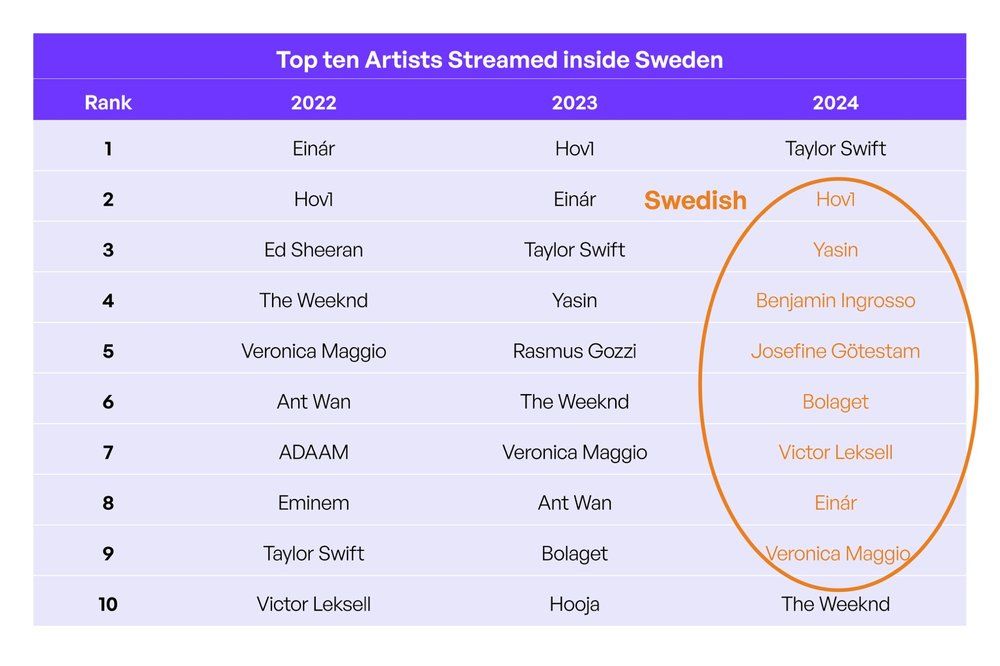
Source: Luminate
Meanwhile, Swedish audiences stream more Swedish artists than Brits stream British – one of a growing number of examples of glocalisation, an emerging hybrid phenomenon of glocalisation and localisation that has seen local music in local language thrive on global platforms.
THE SWEDES ARE MORE SWEDISH ...
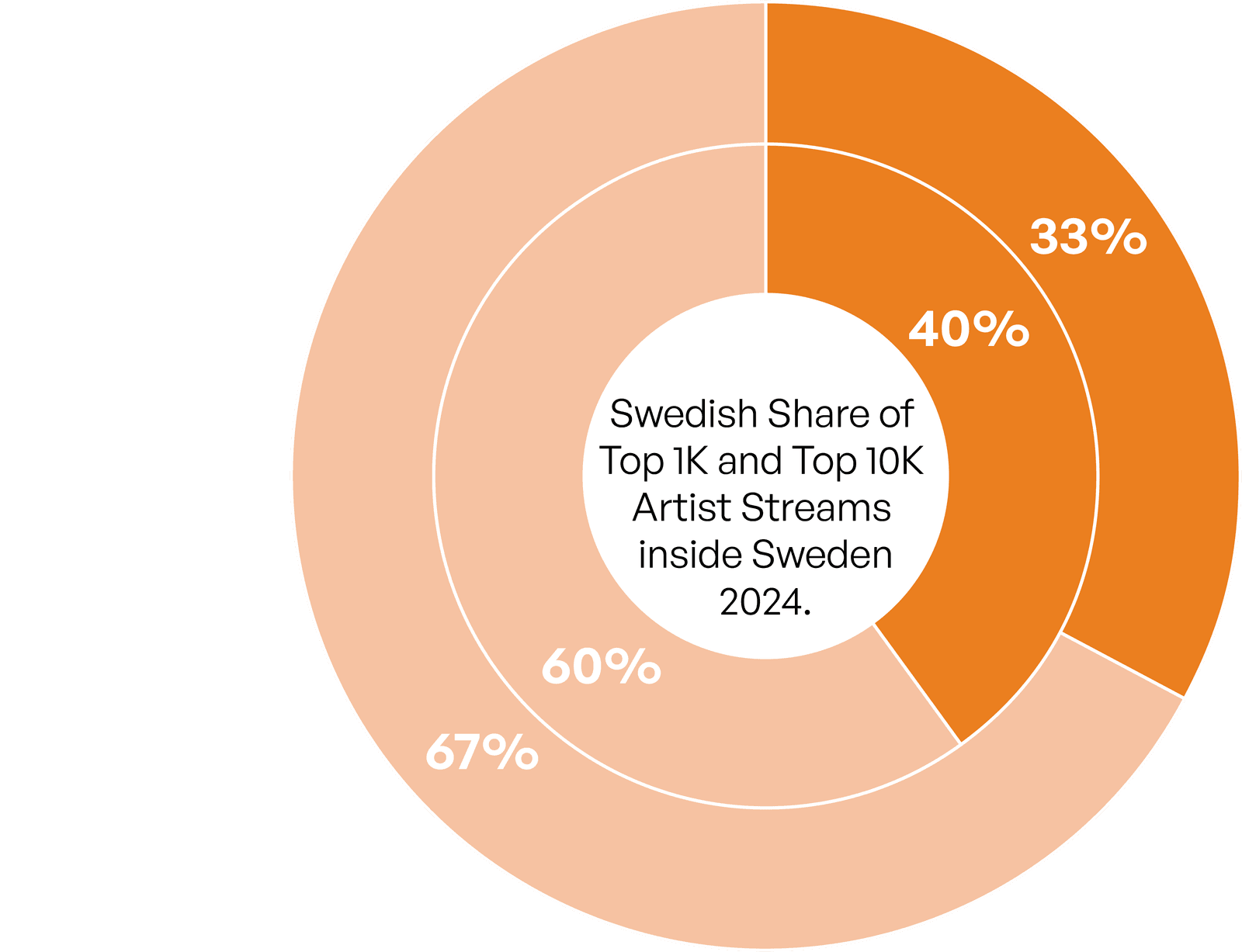
...THAN THE BRITS ARE BRITISH
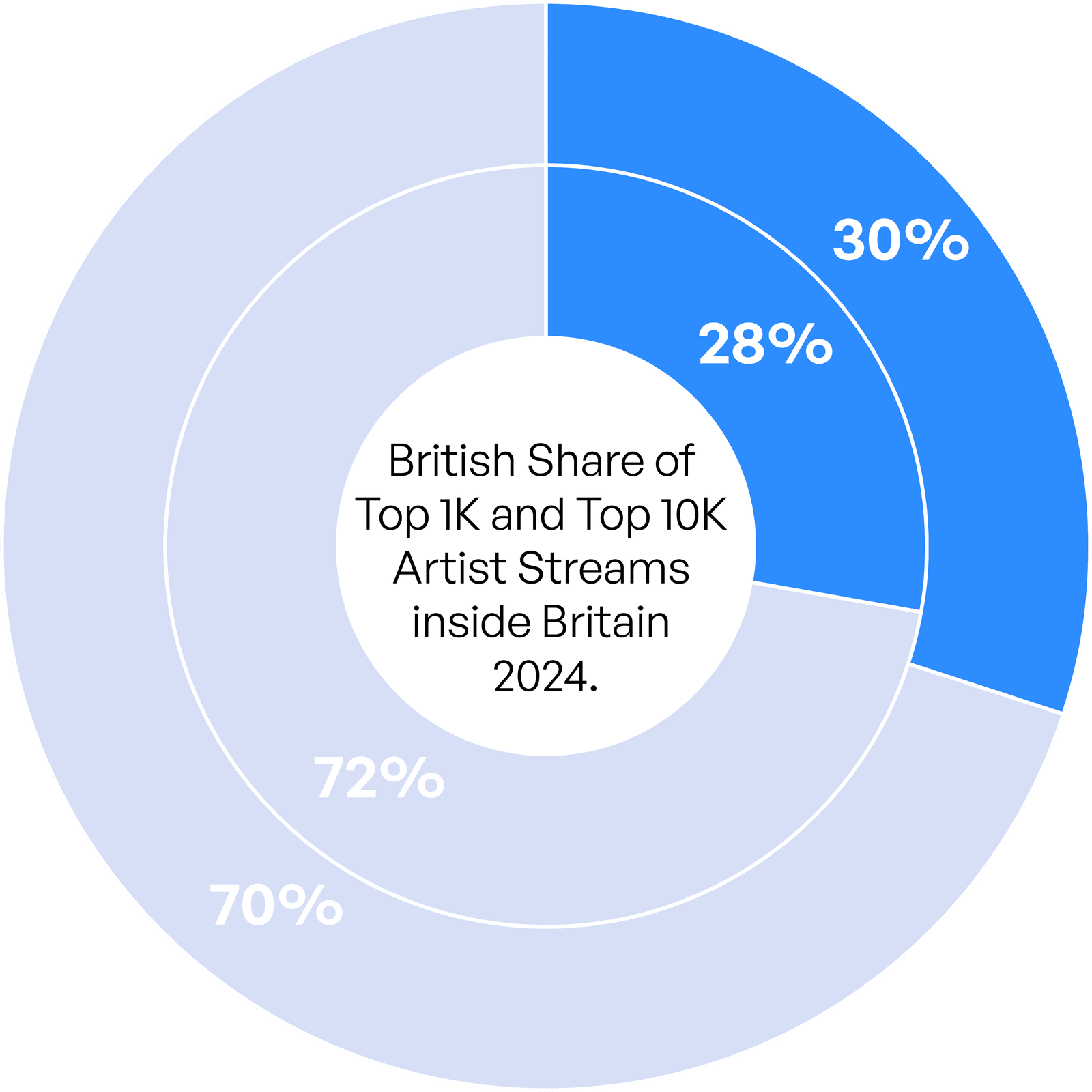
Source: Luminate
Sweden’s songwriting success extends across the world, too. Its musical trade balance — the ratio of money earned from abroad by Swedish songwriters to money sent to songwriters from other countries has reached record highs. Alongside the US, UK, and Korea, Sweden is one of only four net music exporters. 1*
1* This ratio of 2.8 differs from that reported in the 2023 Global Value of Copyright of 1.8 as (i) it relates to 2024 and (ii) the calculation factors in mechanical copyright collections and levy income.
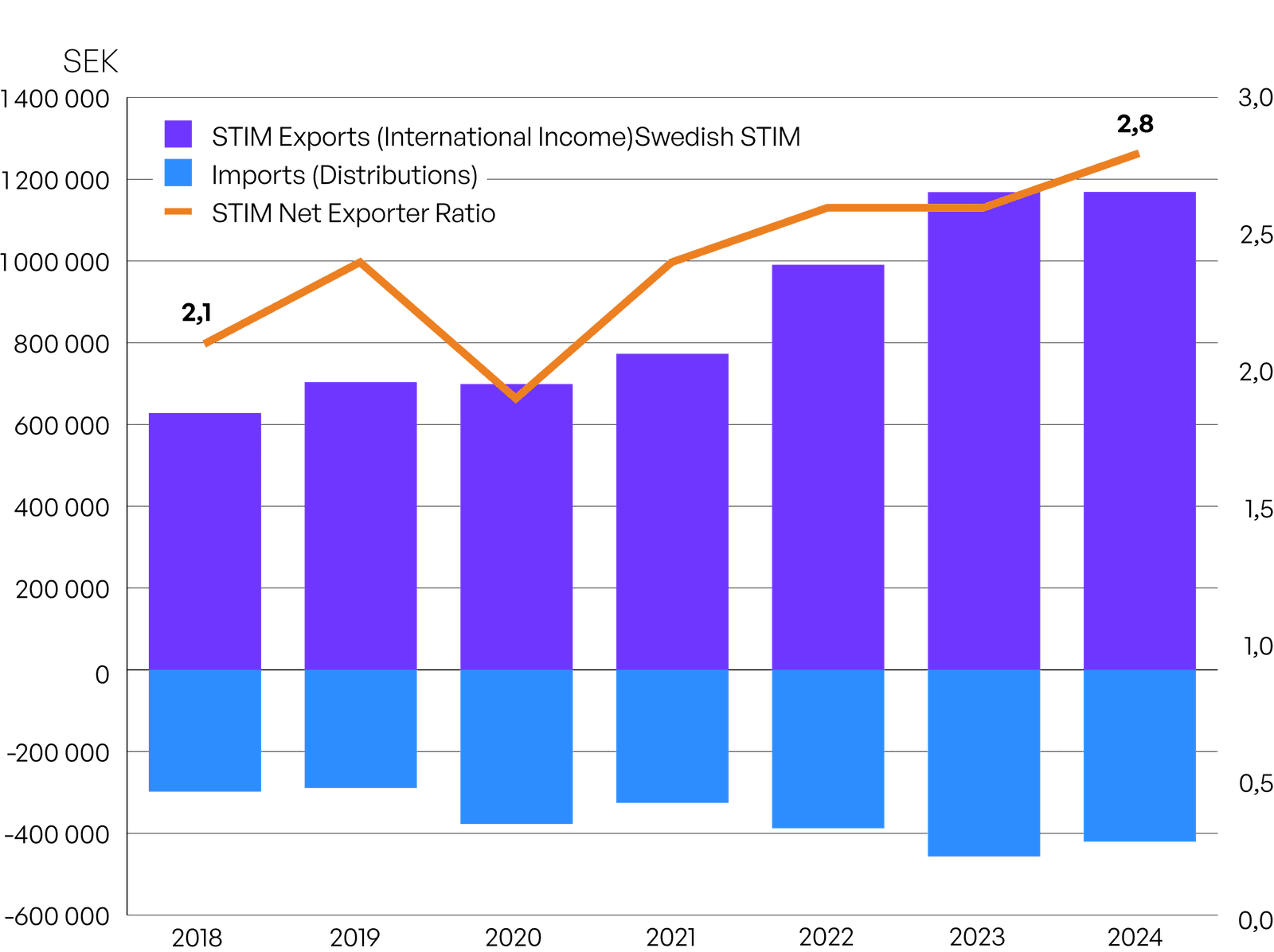
Source: STIM
Swedes find themselves at a crossroads. Domestic markets are drying up. And in other coun- tries, glocalisation is creating new competitive headwinds.
Examining the data in a way never done before can identify where to find the next big export opportunity. Once spotted, government support can help seize it before it slips out of reach.
A Primer on Sweden’s Musical Success
Sweden is a society with a penchant to move first. It pioneered experimenting with a cashless economy and even ironically saw the first musical buskers who accepted card payment. Swe- den was the first to suffer from homegrown piracy sites like Pirate Bay and uTorrent, but first to recover from the domestic remedy of Spotify.
It’s also a first mover in songwriting success, and it’s important to explore why.
‘One possible explanation is that Swedes tend to speak fluent English (far better than us Scots!) and seem to love interpreting what native English speakers are expressing, what words are trending, and reimagining it through both lyrics and melody. And as singer-songwriters like Peter Bjorn & John, Robyn and Tove Lo write in their second language, that may power their message with a relatability that transcends one’s mother tongue.
Another often-cited factor is Sweden’s relatively strong state backing of music education. So is a policy that dates back over half a century which offered teens financial support to form ‘study circles’, many of which devolved (or evolved) into new bands.
Two names are also considered highly influential in Sweden’s musical prowess. ABBA, who along with their fifth member and manager Stig Anderson, exported their Swedish sense of melody, enabling fans worldwide to embrace the angst and the sadness behind it. Denniz Pop, an innovative Swedish producer, died tragically young but not before innovating transfor- mative methods for writing and producing using sampling and synthesizers.
Thanks in part to Denniz Pop, and his understudy Max Martin, the Swedish songwriting “wonder” (colloquially referred to as “låtskrivarunder”) reached a new level in the 1990s when a host of international artists (e.g. Backstreet Boys, NSync and Britney Spears) started flocking to Stockholm to record songs in Cheiron Studios. As these and other globally successful artists came to work in Sweden, Swedish songwriters left their fingerprints on hits that would go on to dazzle the world. Swedish writers effectively established a passport that fast-tracked them to global markets.
Denniz Pop espoused the Swedish mantra that ‘Success is better when it is shared.’ He shared his secret sauce with Stockholm-born Max Martin, who has written 24 Billboard Hot 100 chart-toppers, more than any other music producer, including Taylor Swift, the Weeknd and Britney Spears. Max Martin followed Denniz’s suit and shared his success with a new gener- ation of Swedish writers. Ilya Salmanzadeh, Johan “Shellback” Schuster, Oscar Holter, Tove Lo, Tim “Avicii” Bergling, and Noonie Bao are but a few who carried the torch. The rest, as they say, is (well documented) history. 2*
2* Det svenska popundret | Maher Zain Interview | Det svenska musikundret | 100 år av musikhistoria
Introducing Swedish Songwriters (...there’s a lot of them)
Swedish songwriters and publishers are represented by STIM, a collective management organisation for publishing rights. STIM’s job is simple: license and collect from music users, and distribute those monies to its songwriter and publisher members. And there are a lot of members. As of the end of 2024, 106,000 Swedes were deemed songwriters (albeit with 6.000 deceased but still in copyright). Relatively speaking, that’s four times as many songwriters as the UK.
SWEDEN HAS FOUR TIMES MORE SONGWRITERS PER CAPITA THAN BRITAIN
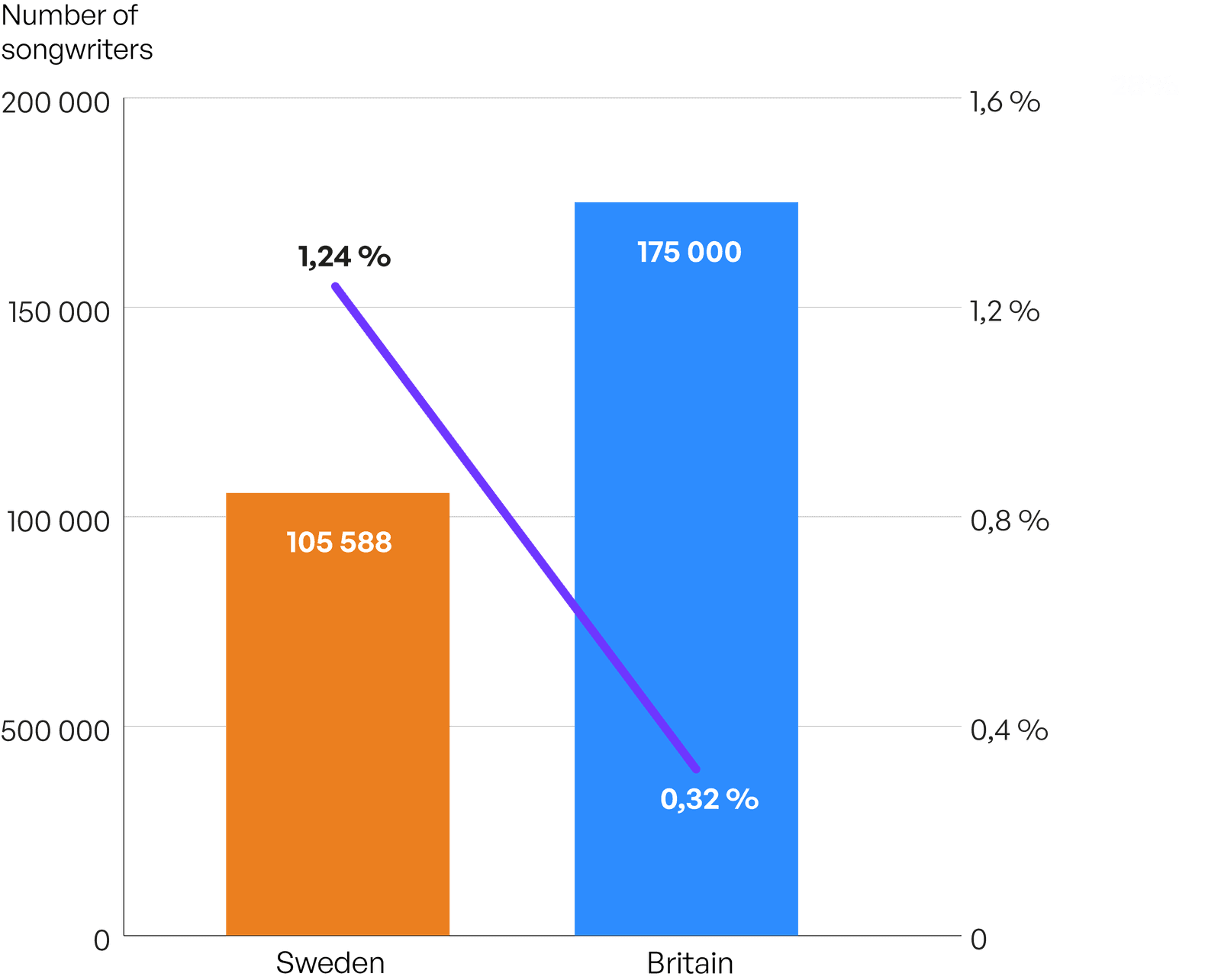
Source: STIM and PRS for Music
Since Spotify launched in Sweden in 2008, STIM membership has nearly doubled, from just under 60,000 to almost 110,000. The growth has been lopsided. While top-tier songwriters, earning more than 1m SEK a year, have increased sevenfold (from 29 to 200), the real growth is down in the long tail where 80% of those new members are currently earning less than 5,000SEK a year. You can’t live on that for a month.
THE LONG TAIL OF STIM MEMBERSHIP IS LONGER (AND SKINNIER) THAN EVER BEFORE
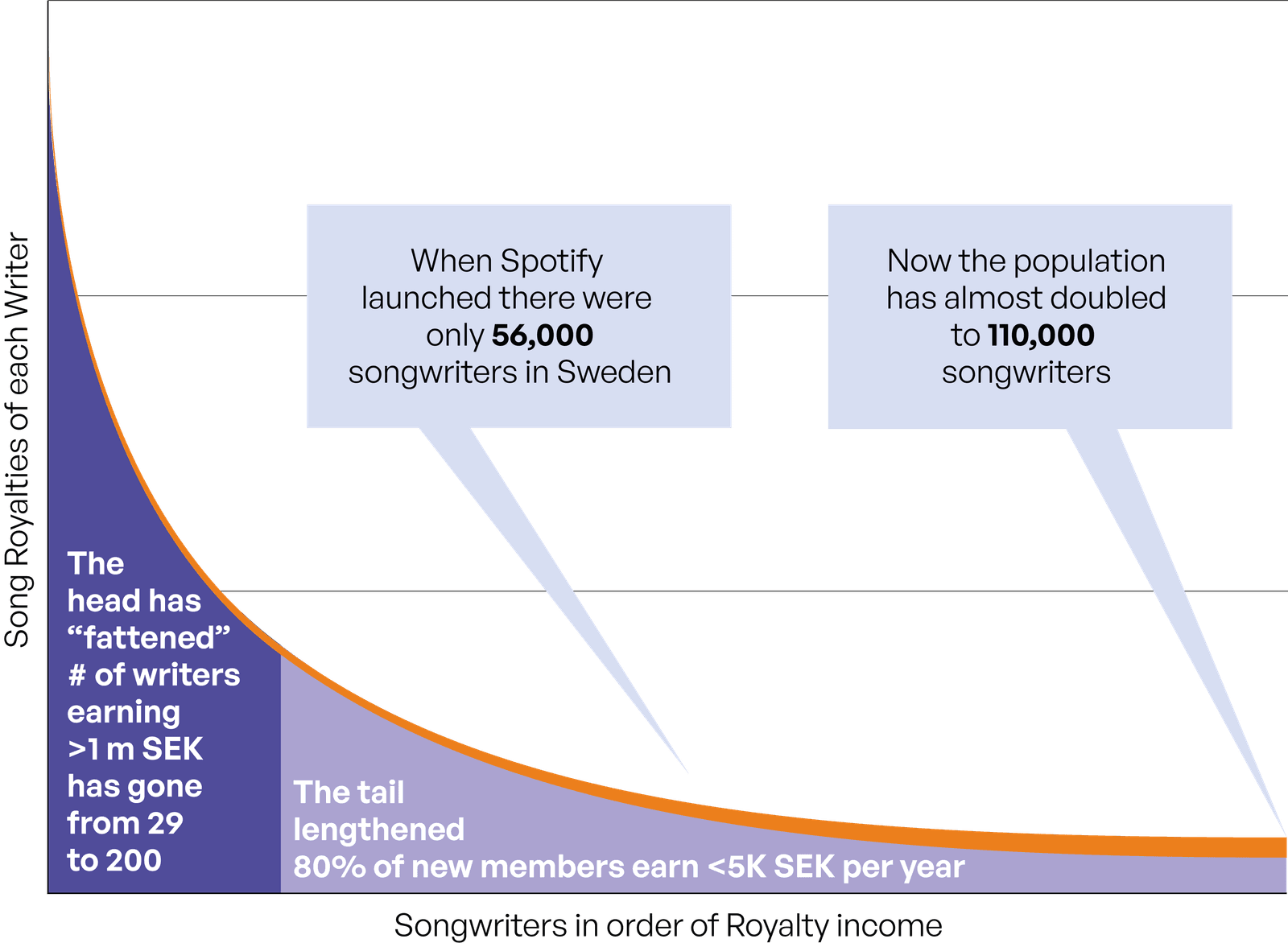
Source: STIM
Sweden faces a dilemma that is familiar across the global music industry: it’ s making more money – STIM reported record high collections and distributions in 2024 – but there are more mouths to feed. As Spotify’s co-founder Daniel Ek pointed out, the old industry was a “pretty restrictive club,” whereas now streaming has democratized access, allowing far more artists to be heard. But that brings new challanges.
Domestic success of STIM’s revenue growth and (even more) member ship growth is to be welcomed, but Swedes shouldn’t be content with being a big fish in a small pond. For de- cades the country has shown it can compete with bigger fish in bigger ponds.
A closer look at STIM’s international collections shows where Swedish songwriters are being heard abroad, and begins to suggest where to find further growth opportunities.
Outside of the neighbouring Nordics (where imports are growing steadily at 20%), most of the rest of the world have doubled their Swedish music imports since 2018. However , it’s Asia which has more-than-trebled from 20m SEK to almost 90m SEK in such a short space of time.
SWEDISH SONGWRITERS ARE INCREASINGLY GETTING HEARD IN ASIA
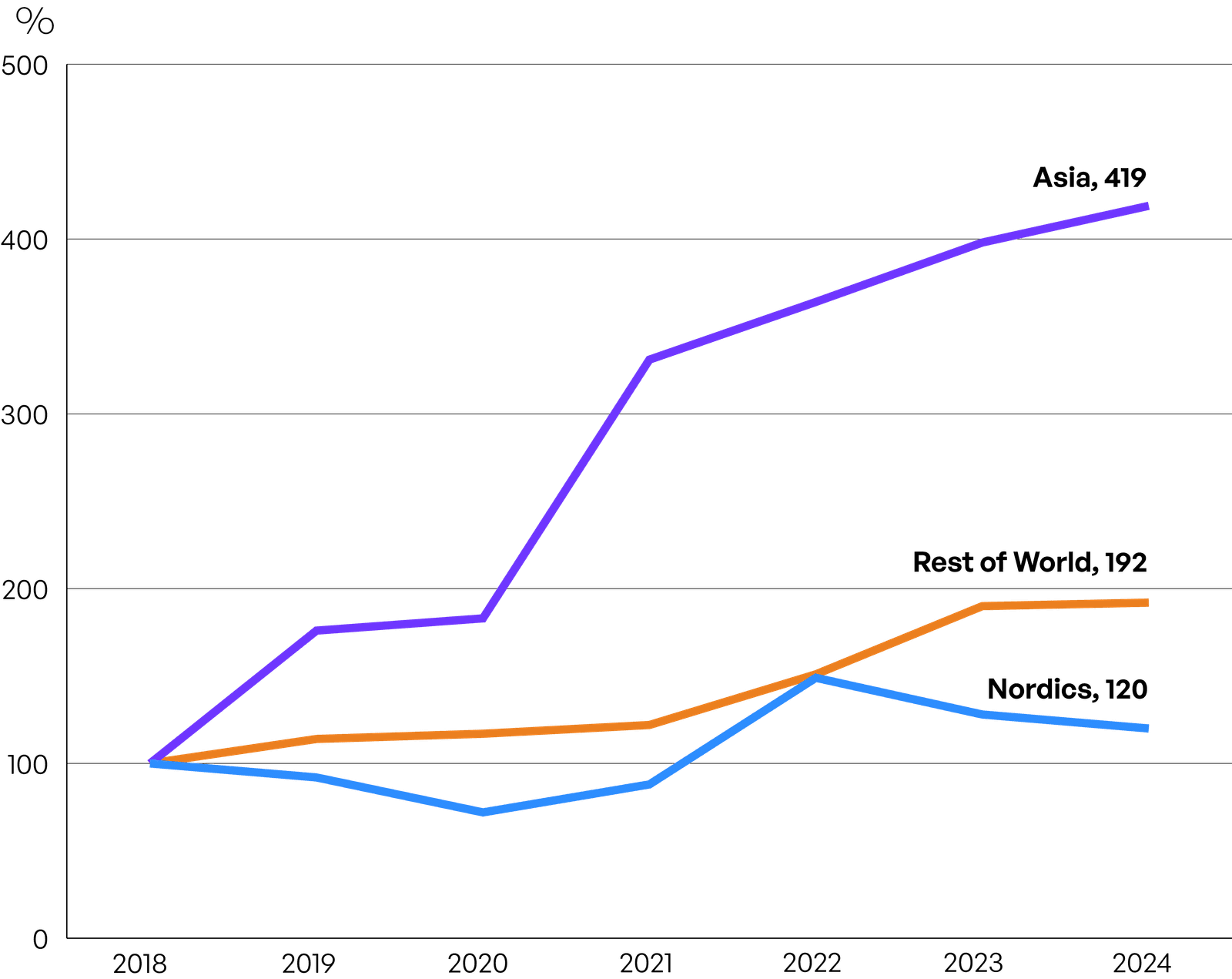
Source: STIM
What’s behind this is a remarkable story: Swedes have cracked the code for K-Pop (the Korean genre that has taken the world by storm). STIM income from K-Pop is up an incredible 1,000% since 2018. In part, this is because STIM has been proactive by creating strategic music licensing partnerships in Asia. But the story of Swedish songwriters’ K-Pop success doesn’t start in Stockholm and end in Seoul: in fact, for every krona that Swedes earn from Korea, they’re seeing another two kronas from their K-Pop hits being heard elsewhere around the world.
SWEDES ARE WRITING K-POP HITS, AND THE REST OF THE WORLD IS LISTENING
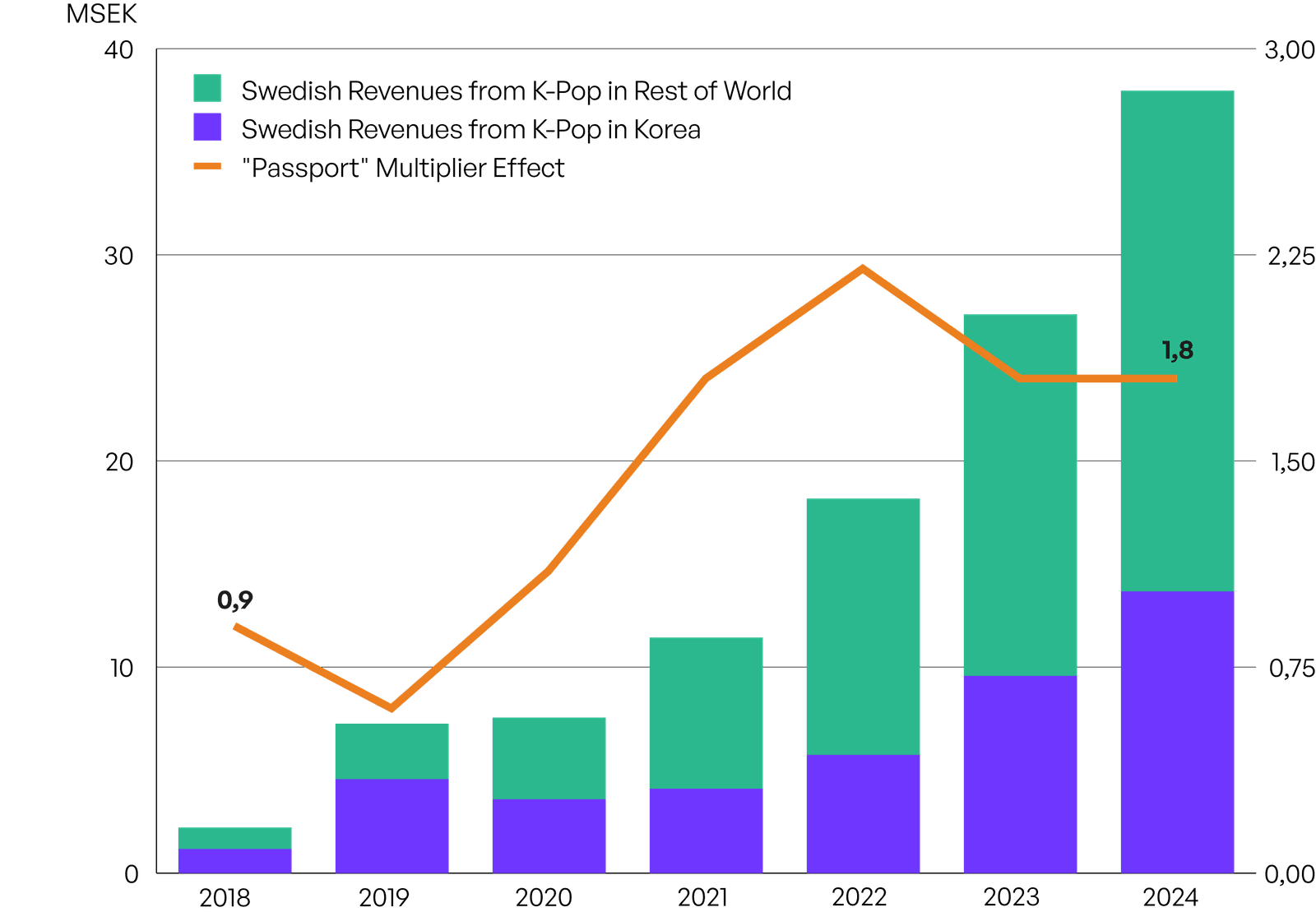
Source: STIM
All of this may sound a little self-serving, but it’s not. Rather than listen to a Scot heaping praise on Swedes, instead listen to Korea’s biggest K-pop label exec themselves:
Collaborating with songwriters from Sweden and the broader Nordic region is becoming increasingly important in the K-pop industry. Their music resonates deeply with Korean sensibilities, and their outstanding musical talent adds richness and texture to the K-pop sound. Nordic writers have a unique ability to express nostalgia and emo- tion through beautiful melodies, which strongly connected with K-pop fans around the world. To create music that aligns with each artist’s unique direction, we often host songwriting camps in the Nordic region or collaborate re- motely. Every time we work together, we’re struck by how naturally close and warm the environment feels–almost like working with family or friends. You can see this right now with the success of ‘ILLIT (아일릿) ‘빌려온 고양이 (Do the Dance)’ which was co-written by STIM members Moa “Cazzi Opeia” Carlebecker (Sunshine) and Ellen Berg. The song was released on Monday 16th June and has passed 20m views on YouTube. Working with nordic songwriters isn’t just about bringing a fresh sound to K-pop; it’s also about experiencing a culture where music is made with joy and sincerity. We look forward to expanding our musical horizons even further through more sessions with these talented partners”
– BELIFT LAB, one of the biggest K-Pop labels belonging to HYBE, a South Korean global entertainment company
ILLIT (아일릿) '빌려온 고양이 (Do the Dance)' Official MV
Digging deeper, we find that the make-up of this new generation of songwriters is distinct from that of Sweden’s legendary English-language writers. All of the top 10 writers in English (e.g. Max Martin, Shell- back) were male, yet among the Swedes K-Pop hits, half are women (e.g. Moa ‘Cazzi Opeia’ Carlebecker, Ylva Dimberg). And while 70% of the top English-lan- guage Swedish writers are older than 40, 70% of the top Swedish K-pop writers were under 40.
Johan Lagerlöf Managing Partner at Pophouse Investments cites the songwriting school Musikmakarna as a key contributor to this diversity, highlighting its promotion and education of both girls and boys in songwriting.
THE CHANGING FACE OF SWEDISH SONGWRITING SUCCESS
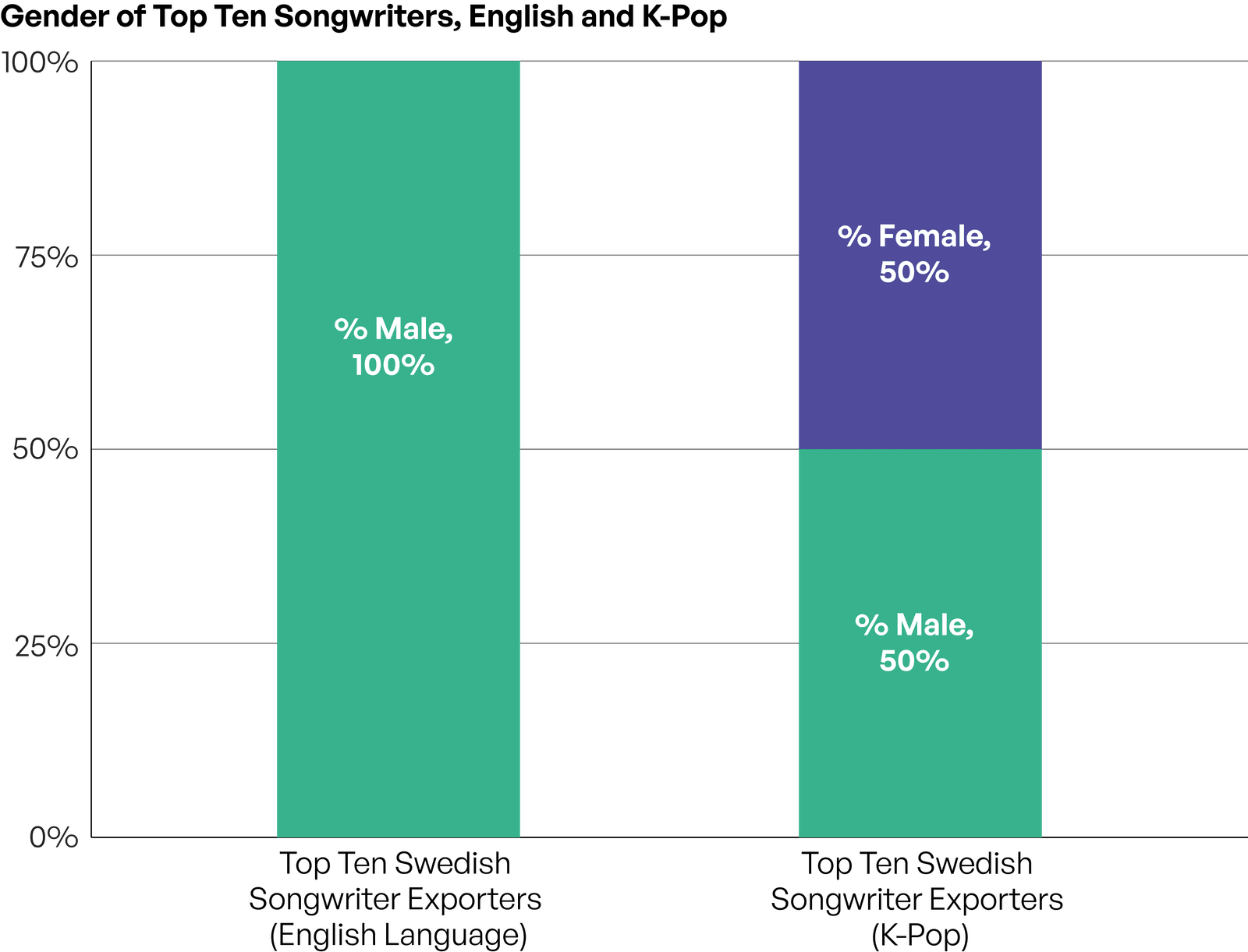
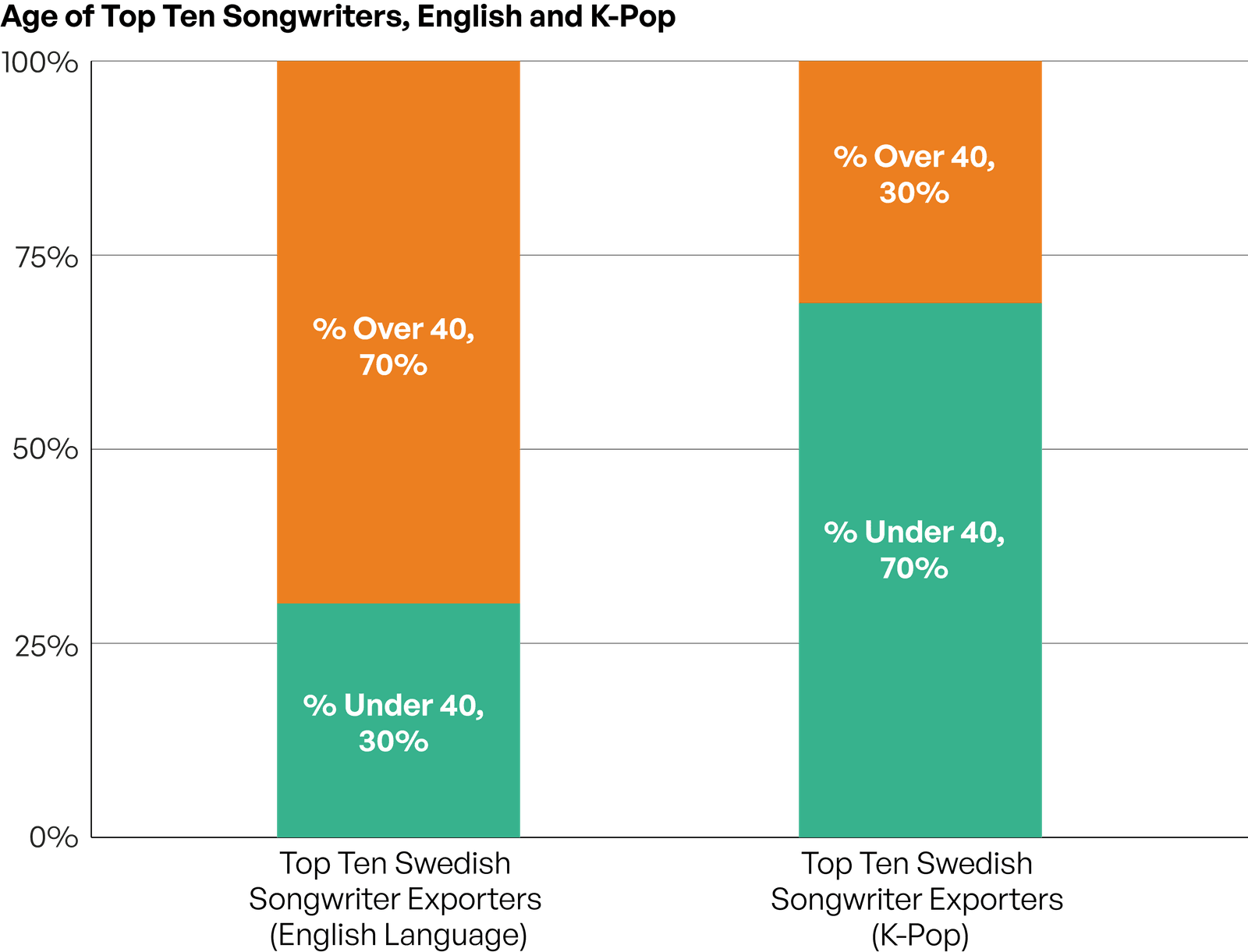
Source: STIM
For Lagerlöf, the formula for this success is “a mix of music cultures”. Swedes, he argues, “are brought up with some kind of ABBA sticky melodies and chord progressions in their heads, which, when blended with American vocals or Korean culture, takes it up a notch.” Lagerlöf sees this as two-way trade, as today’s American pop sound is actually part Swedish, adopting many tricks of the trade — namely “don’t bore us, get us to the chorus.”
Why Swedish Exports Matter More than Ever
As mountaineers would testify, just when you’ve reached what you thought would be the high- est peak, you often need to buckle up and climb higher. And despite the remarkable collective achieve-ments of Swedish songwriters – in Sweden, across the English-speaking world, and most re-cently into the new territory of K-Pop – higher peaks beckon.
Spotify reached critical mass in Sweden well over a decade ago, and there are clear signs that Swedish artists are facing market saturation as their domestic streams atten. Their overseas streams, however, are taking off. Indexing Spotify data of Swedish artists’ streams shows domestic streams rising by 50% since 2018, whereas streams from abroad have more than doubled. Daniel Jäger, Head of International at STIM concurs: “Back in 2018, for every krona our members earned from streaming in Sweden, they were getting around 1.5 from overseas. Today, that ratio has expanded to almost 5”. Exports matter more than ever before.
WHY THE GRASS IS GREENER ON THE EXPORT SIDE (2018 = 100)
.png?w=1600)
Source: Spotify
For Swedish artists, the need to export is straightforward—when faced with saturation at home, the grass is greener on the export side. For songwriters, whose copyrights can be per- formed by many artists (and in many languages), this comes with a twist: if music markets are “glocalising”, that means more local hits and fewer global ones. But if Swedes can fi ure out how to micro-target foreign markets, this dynamic creates more opportunities to top more charts.
So, Where Next?
Where should Swedish songwriters place their bets? One option is to follow where Swedish artists are already having success. Another is to do the reverse, and ask where songwriters are making inroads away from their artist counterparts.
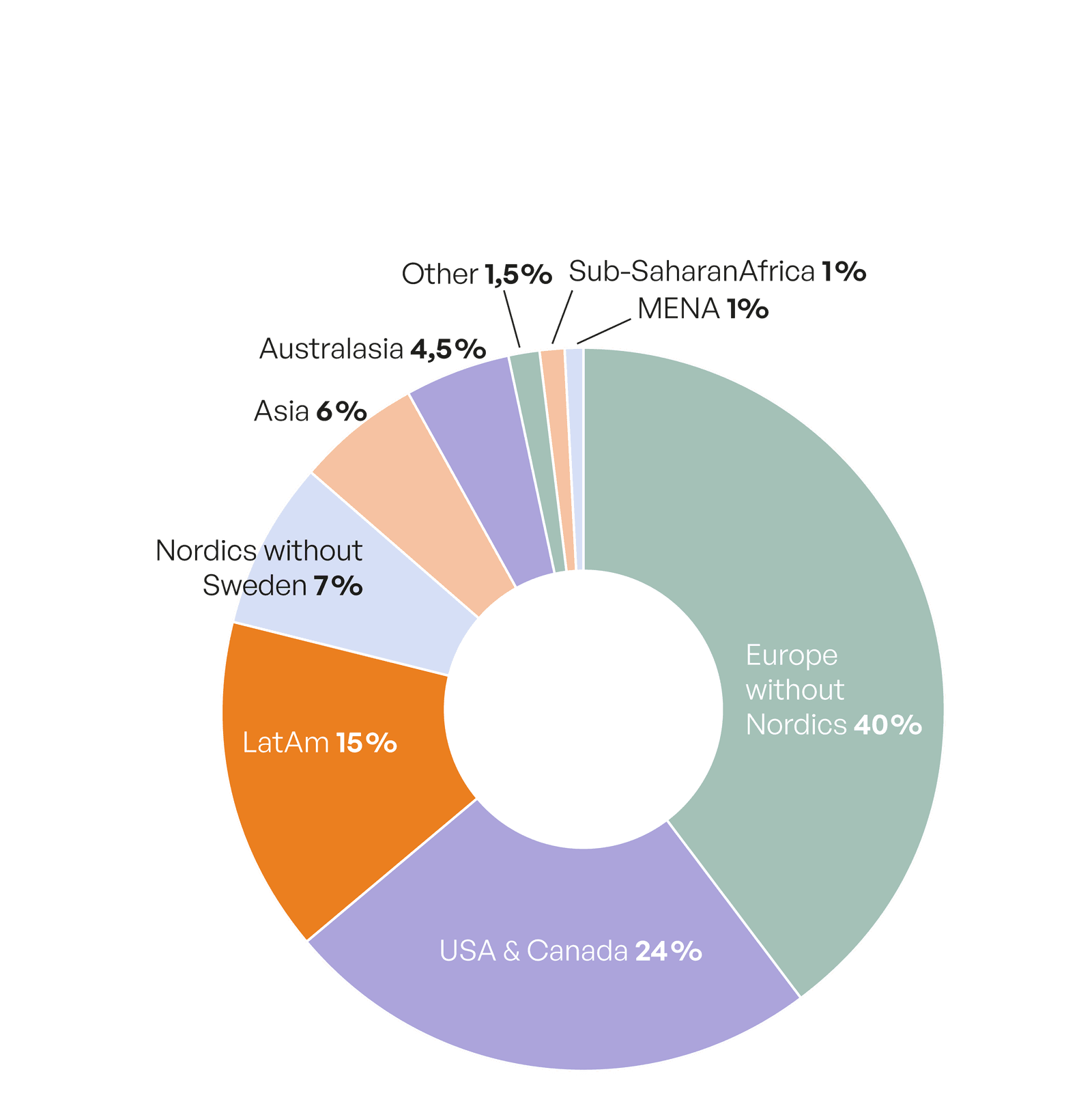
For option one Spotify has generously offered data that shows where those Swedish artists are being streamed overseas. Note this is the volume of streams on Spotify, not the value of those streams to the artist.
What is striking about this snapshot is that Latin America is now delivering double the stream- ing volume to Swedish artists compared to that of the Nordics.*3
Stockholm’s Zara Larsson as the artist will reap the rewards through her record label Sommer House, distributed by Sony Music Sweden. However, for Zara Larsson as the songwriter, this exposure could create a slip- stream for other songwriters and publishers to follow.
WHERE IN THE WORLD THOSE SWEDISH ARTISTS ARE BEING STREAMED IN 2024
Source: Spotify
Comparing the exports of Swedish artists and songwriters is akin to ‘apples and pears’ as they have, of course, different rights and sources of revenues. But we can hack together a more apples-to-apples comparison to see if any notable outliers exist.
Economics can help. Pricing the Spotify artist export regions — where a stream in Latin Amer- ica or Asia is worth less than Europe — allows us to compare the revenues of Swedish artists with that of the international income that STIM collects on behalf of its songwriters.
*3 “Latam” is used in the broadest sense to capture all of South and Central America, including Mexico
While many of the results are similar (e.g. Europe, North America are the breadwinners for both), the aforementioned Asian outlier raises its head again: Asia made up only 3% of value-adjusted artist income but 8% for songwriters.
WHERE ARTISTS AND SONGWRITERS ARE BEING HEARD AROUND THE WORLD
.png?w=1600)
Source: Spotify and STIM
Asia doesn’t just mean Korea for Swedish songwriters, but we’ve documented the incredible success they’ve had writing K-Pop hits that travelled beyond Seoul, sending even more royal- ties back to Stockholm. Why not have STIM’s publishers and songwriters join the K-Pop labels for the joyride and expand their own horizons? With the leading K-Pop label HYBE reportedly eyeing up opportunities in India, perhaps this will break down borders for Swedes to write and publish hits for Indian pop artists, too.
India’s influence extends beyond its own borders too. As I explained in last year’s Global Copy- right Report, the second most-streamed language in Canada today is (not French, nor Span- ish but) Punjabi. And these Punjabi-Canadian artists are crushing it in Canada and even more so in India — a country with thirty five-times the population. This is a stark reminder of the value of diasporas — a diverse and overlooked opportunity that is not currently being served by Sweden’s music exports.
My job is to frame this opportunity, your job is to debate it. When you do, you should recognise that music merits debate alongside any other part of the Swedish economy. Sweden has a rare comparative advantage in writing and recording music. But its continuation cannot be taken for granted as glocalisation upends the status quo. It took STIM just over 100 years to bring annual international income for its members beyond the 1bn SEK mark. Get this right and in the next 10 years STIM could grow that to 2bn SEK.
Acknowledgements
The author would like to thank Lina Heyman, Anton Waltari, Pär Fridholm, Patrik Sventelius, Daniel Jäger, and Simon Gozzi at STIM; Scott Ryan, Jaime Marconette, and Mary Nwangwu at Luminate; Bill Gorjance at peermusic; Yongmin Cho at HYBE, Gorm Arildsen and Martin Folmann at KODA; Chris Macowski and Eliot Van Buskirk at Spotify; Johan Lagerlöf at Pophouse; Jesper Thorsson, Export Music Swe; Ludvig Werner, IFPI Swe- den; Jules Parker; Tom Frederikse at Clinton’s; Ralph Simon at Mobiliium; and the wordsmith Sam Blake for copyediting the report.
About the Author
Will Page is the author of the critically acclaimed book Tarzan Economics, which has been translated into five languages and published in paperback under the title Pivot. As the former Chief Economist of Spotify and PRS for Music, Will pioneered Rockonomics and shined a spotlight on Glocalisation, showing how and why local artists singing in their mother tongues are topping the charts on global streaming platforms. At Spotify, Will launched his ongoing and widely anticipated annual report on the global value of music copyright, and at PRS he saved BBC 6Music. A passionate communicator, he is a regular con- tributor to BBC, Financial Times, and The Economist. Will also serves as a fellow at the London School of Economics, Edinburgh Futures Institute, and the Royal Society of the Arts.